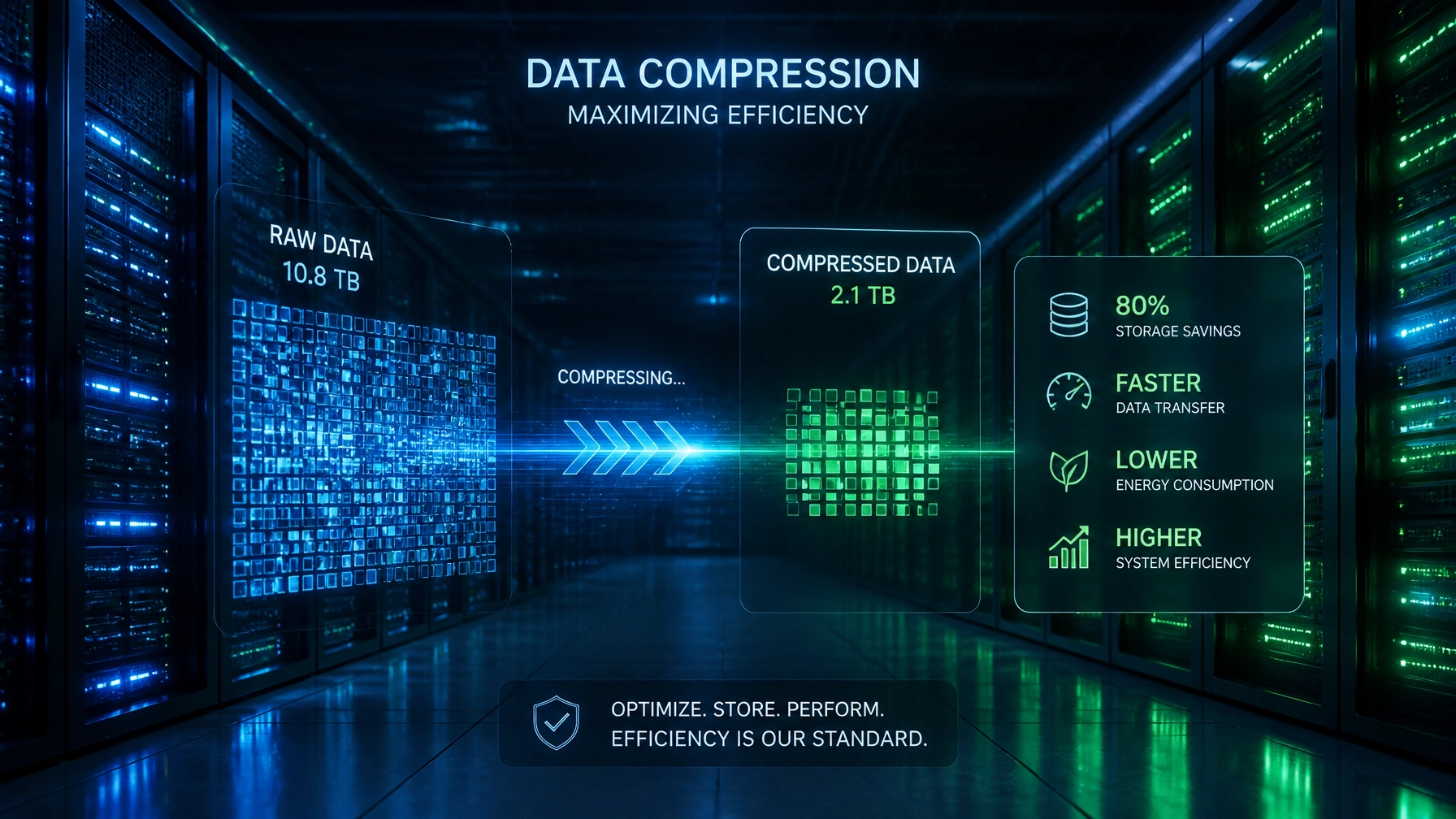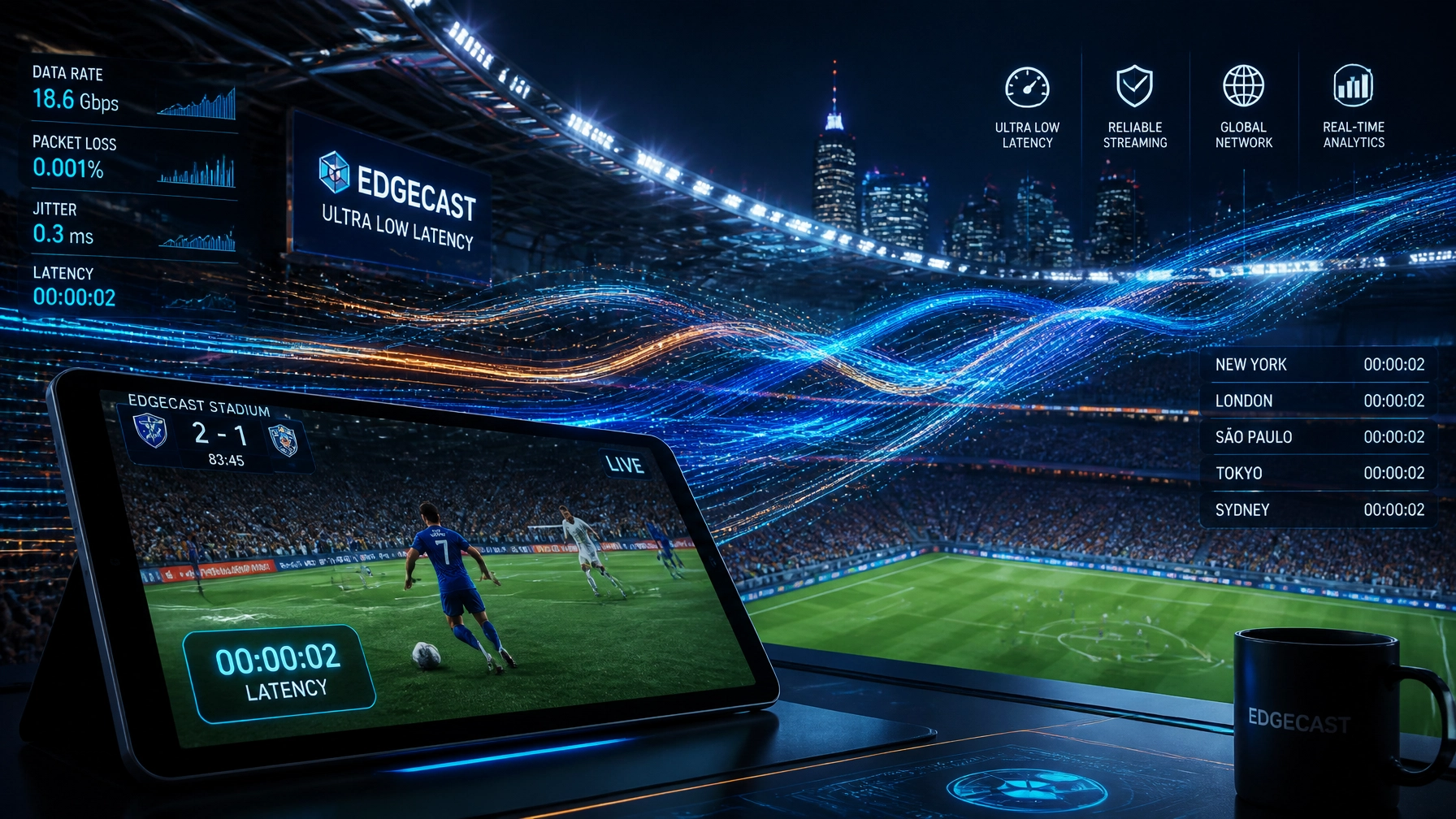
If you’re running a streaming service or managing a data center in 2026, your power bill is probably your biggest headache. As resolutions climb toward 8K and frame rates hit 120fps, the sheer math of moving pixels is becoming an environmental and financial liability.
The debate used to be about quality: "Software encoding looks better; hardware encoding is faster." But today, the conversation has shifted. In a world of carbon taxes and skyrocketing energy costs, the real question is: Which one is going to keep your data center from melting?
At the Data Transmission Efficiency Alliance (DTEA), we look at the hard data. We’ve analyzed the benchmarks, and the gap between software and hardware efficiency isn't just a few percentage points: it’s an order of magnitude.
The Contender: Software Encoding (The Brute Force Approach)
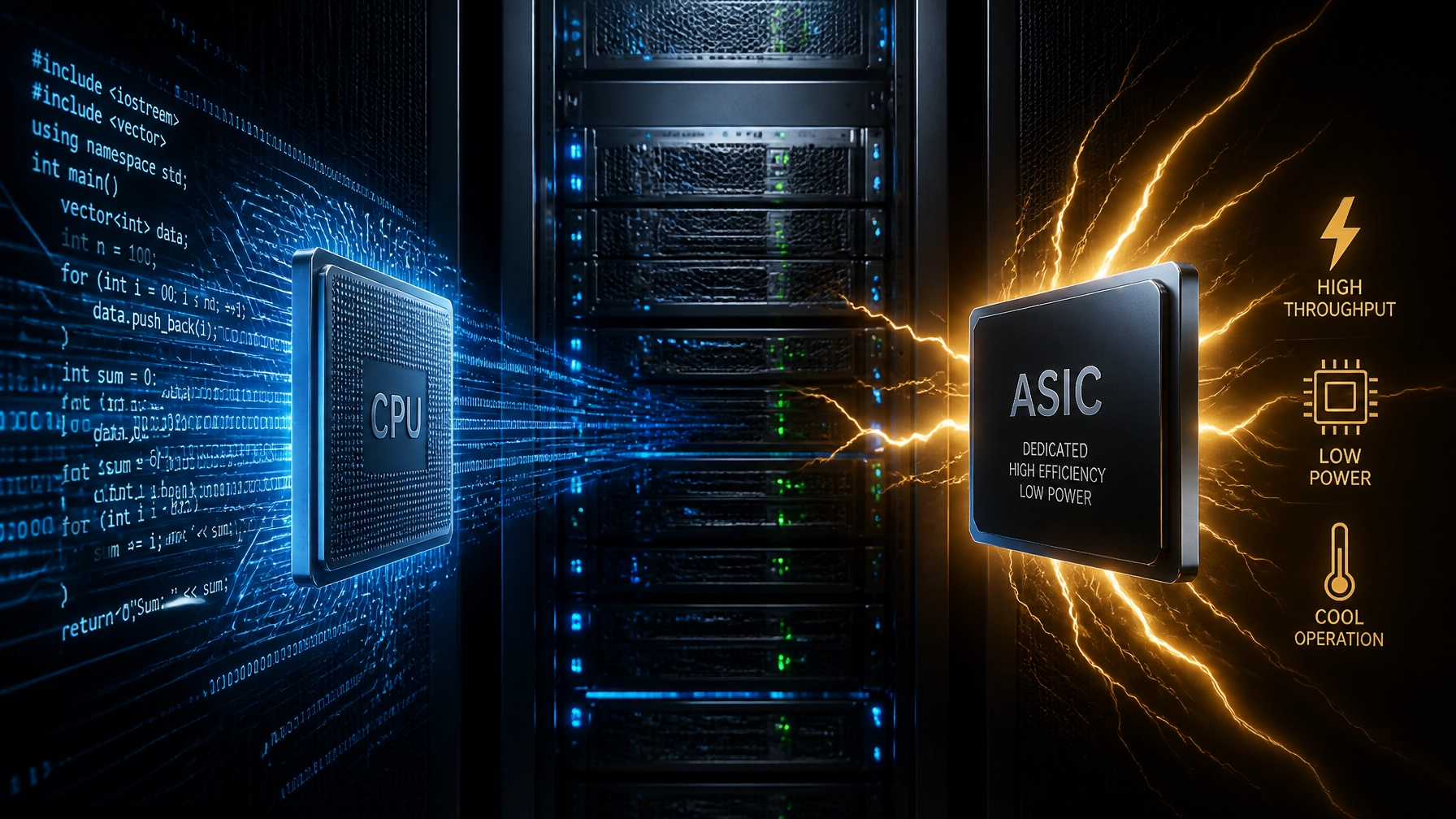
Software encoding relies on a general-purpose Central Processing Unit (CPU). When you use libraries like x264, x265, or the newer SVT-AV1, you are essentially asking a "Jack of all trades" chip to solve a very specific, incredibly complex mathematical puzzle.
Because a CPU is designed to handle everything from operating system kernels to spreadsheet calculations, it isn't optimized for the repetitive, heavy-lifting math required for video compression.
Why It Eats Power
To achieve the best possible quality (highest Rate-Distortion performance), software encoders use "slow" presets. These presets force the CPU to run at high clock speeds, utilizing AVX-512 instructions and saturating every available core.
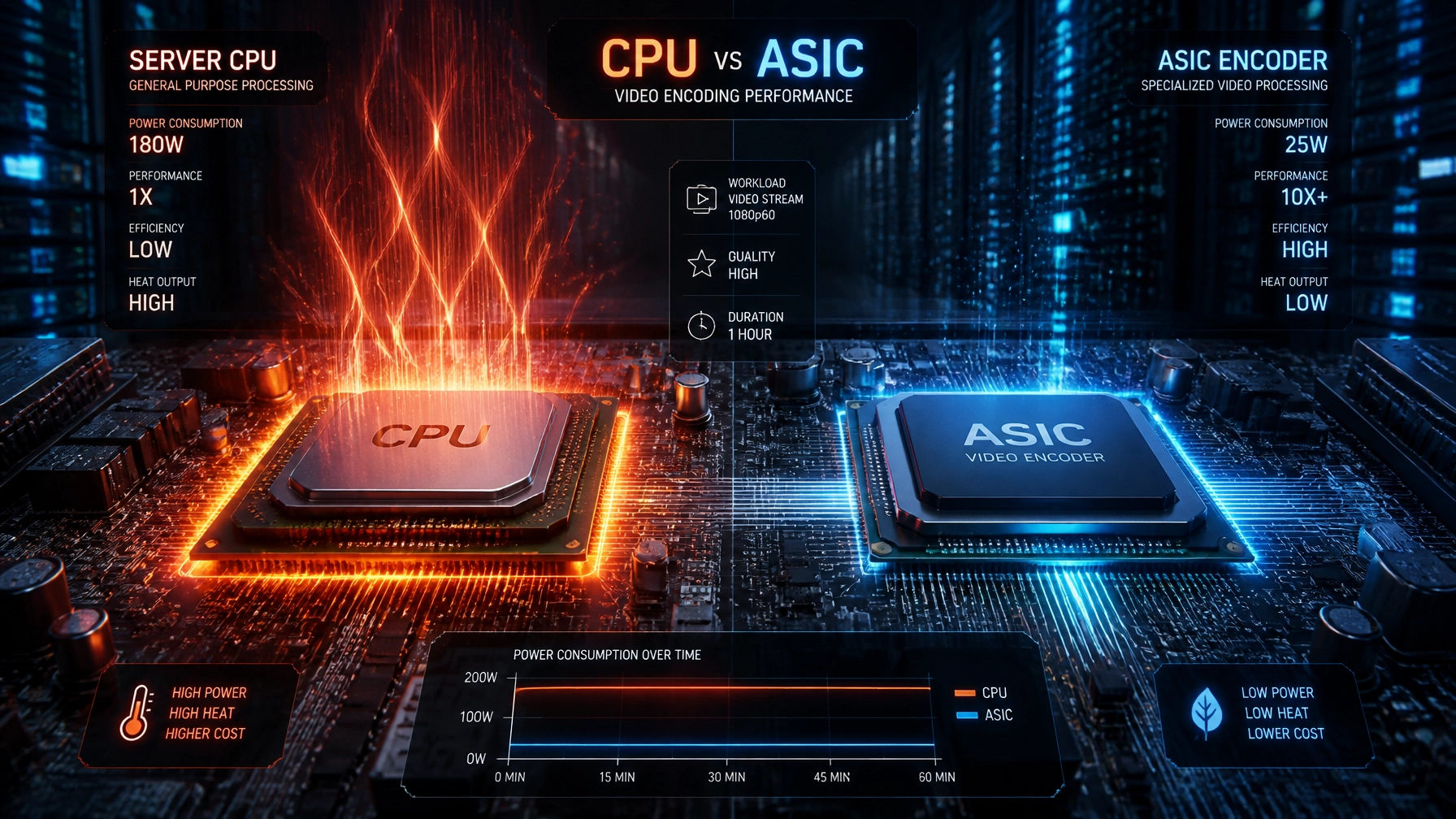
For a single 4K stream, a high-end CPU like a Ryzen 9 or a top-tier Intel Xeon can easily sit at its Thermal Design Power (TDP) of 150W to 250W. In a data center context, that translates to massive cooling requirements. You aren't just paying for the electricity to run the chip; you’re paying for the industrial AC to pull that heat out of the room.
The Verdict: Software offers the best quality-per-bit, but it has the worst "Watts-per-stream" ratio in the industry.

The Middle Ground: GPU Hardware Encoding
Most modern GPUs (like NVIDIA’s NVENC or Intel’s Quick Sync) include a "fixed-function" block. This is a dedicated piece of silicon on the chip that does nothing but encode and decode video.
When you use a GPU for encoding, you aren't actually using the "Cores" that render 3D graphics. You’re using a tiny, specialized neighborhood on the chip. This is why you can stream a game in 4K using NVENC without your frame rate tanking.
Efficiency Gains
Because these blocks are hard-wired for video math, they are significantly more efficient than a CPU. A GPU might have a TDP of 300W, but if you’re only using the encoder block, the actual power draw attributed to the video task is remarkably low: often just a few watts above idle.
In real-world testing, GPU hardware encoders can handle 4K real-time throughput while the total system power remains 2x to 3x lower than a CPU-only software approach. For live streaming, where "good enough" quality at low latency is the goal, GPUs are a massive step up in efficiency.
The Champion: Dedicated ASIC Encoders
If you want to see what peak efficiency looks like, you have to look at Application-Specific Integrated Circuits (ASICs). These aren't general-purpose chips, and they aren't even graphics cards. They are PCIe cards designed for one thing and one thing only: high-volume video transcoding.
Companies like Google (with their Argos VCU) and Netint have proven that when you strip away everything except the encoding logic, the power savings are staggering.
The 90% Reduction Fact
Recent industry case studies have shown that migrating a high-volume transcoding workload from CPU-only software to dedicated ASIC cards can reduce total power consumption by more than 90%.
Let’s look at the math from a typical large-scale deployment:
- CPU Baseline: 325,000 Watts to handle a production workload.
- GPU Stage: 112,350 Watts for the same workload (a 3x improvement).
- ASIC Stage: 33,820 Watts for the same workload (a nearly 10x improvement from the baseline).
At the card level, modern ASICs can produce roughly 25 Full HD (1080p) streams at just 27 Watts per card. That’s roughly 1 Watt per stream. For a data center managing thousands of streams, this is the difference between a sustainable business model and a financial black hole.

The Quality vs. Power Trade-Off
Critics of hardware encoding often point to "Rate-Distortion" (RD) curves. Historically, software encoders could produce a better-looking image at a lower bitrate than hardware encoders. This meant software saved you money on egress fees (bandwidth) but cost you more in power fees.
However, the gap is closing. Modern hardware blocks in the latest generations of chips (like the AV1 encoders in NVIDIA 40-series or the latest Intel data center GPUs) now match the quality of "Medium" software presets.
In the DTEA certification process, we look at the "Efficiency Frontier." This is the point where you balance:
- Bitrate Efficiency (Storage and delivery costs)
- Compute Efficiency (Power and hardware costs)
- Visual Quality (Customer satisfaction)
For 99% of streaming applications: including social media, live sports, and corporate video: the slight quality edge of a "Slower" CPU preset does not justify the 10x increase in power consumption.
Why This Matters for Sustainability (ESG)
ESG (Environmental, Social, and Governance) reporting is no longer optional for big players like Netflix, Prime Video, or AWS. Data centers currently account for about 1-2% of global electricity use, and video accounts for over 80% of internet traffic.
If your organization is still transcoding on general-purpose CPUs, you are leaving a massive carbon footprint on the table. Moving to hardware-accelerated encoding is the "low-hanging fruit" of data center sustainability. It’s one of the few instances where the greener choice is also the significantly cheaper choice in the long run.
Total Cost of Ownership (TCO)
When calculating TCO, you must look beyond the initial purchase price of the hardware.
- Density: One ASIC server can often replace 10-15 CPU-only servers. That’s 15x less rack space.
- Cooling: Lower power draw means your HVAC system isn't working overtime.
- Longevity: Hardware encoders running at low thermal loads tend to have longer lifespans than CPUs pushed to 100% load 24/7.

Conclusion: Which Should You Choose?
The data is clear. If you are operating at any kind of scale, hardware encoding: specifically ASIC-based: is the only way to stay energy-efficient.
- Use Software (CPU) if: You are a boutique post-production house doing "gold master" encodes where every single bit of quality matters and power consumption is an afterthought.
- Use GPU Hardware if: You are a gamer, an individual streamer, or a mid-sized company needing a balance of flexibility and speed.
- Use ASICs if: You are a streaming platform, a CDN, or a data center operator. The 90% power reduction is too large to ignore.
At the Data Transmission Efficiency Alliance, we are working to create the first independent certification system for these technologies. We believe that efficiency should be measurable and transparent. Whether you are a vendor or a consumer, knowing the "Watts-per-stream" of your tech stack is the first step toward a more efficient future.
Interested in how your tech stack stacks up? Check out our mission at DTEA.org and join us in setting the new benchmarks for the streaming era.