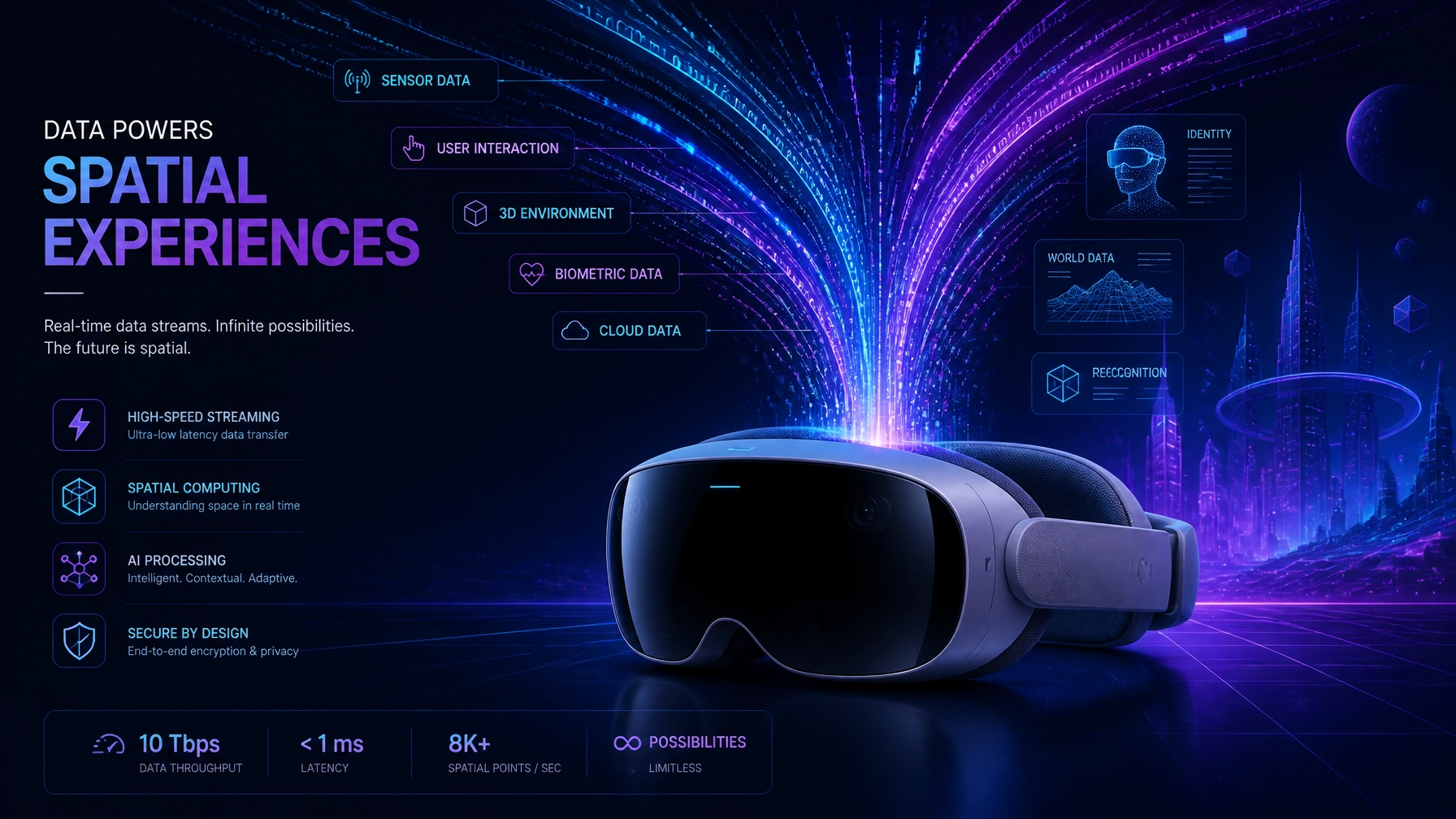
The dream of the "Metaverse" isn't just about wearing a pair of ski goggles and looking at cartoons. With the arrival of devices like the Apple Vision Pro and the Meta Quest 3, we’ve officially entered the era of Spatial Computing. We aren't just looking at screens anymore; we’re living inside them.
But here’s the cold, hard truth that most marketing teams won't tell you: the infrastructure under the hood is screaming.
If you thought 4K streaming was a bandwidth hog, you haven’t seen anything yet. Spatial computing and high-fidelity VR require a level of data transmission efficiency that current standards simply weren't built for. At the Data Transmission Efficiency Alliance (DTEA), we’re looking at the numbers, and they are staggering.
Are your codecs actually ready for this, or is your immersive experience about to buffer into oblivion?
The Math of Immersion: Why 4K Isn't Enough
In a traditional setup, you’re looking at a 4K TV from across the room. The pixels are tiny, and the "Pixels Per Degree" (PPD) is high enough that your eye can’t distinguish individual dots. This is the "Retina" standard we've grown used to.
However, in a VR headset, those screens are an inch from your eyeballs. To get that same high-fidelity quality in a 360-degree environment, you don't just need 4K: you need 8K, 12K, or even 16K per eye. When you factor in high frame rates (90Hz to 120Hz is the bare minimum to avoid motion sickness) and stereoscopic 3D, you’re looking at data rates that can easily top 1 Gbps uncompressed.
Even with current compression, we’re talking about sustained 50–100 Mbps streams just for a decent experience. For most home Wi-Fi and 5G networks, that’s a "break glass in case of emergency" scenario.

The Codec Battle: HEVC vs. AV1 vs. VVC
The industry is currently caught in a three-way tug-of-war. Each codec claims to be the "saviour" of the metaverse, but they all come with significant trade-offs.
1. HEVC (H.265): The Old Reliable
Currently, HEVC is the king of VR. It’s supported by almost every headset on the market (Meta, Pico, Apple). It’s efficient, it’s stable, and the hardware decoders are mature.
- The Problem: It’s hitting its ceiling. We’ve squeezed about as much efficiency out of H.265 as we can. For 8K spatial video, the bitrates are still too high for most global internet connections. Furthermore, the licensing fees are a constant headache for streaming platforms.
2. AV1: The Open-Source Contender
AV1 is the royalty-free darling of the internet. It's roughly 30-40% more efficient than HEVC, which sounds like a dream for streaming giants like Netflix or YouTube.
- The Problem: Encoding AV1 in real-time is a computational nightmare. It requires massive amounts of processing power, which leads to high latency and massive energy consumption in data centers. While hardware support is growing, we aren't at "universal adoption" yet, especially in the mobile chipsets used in standalone headsets.
3. VVC (H.266): The VR Specialist
Versatile Video Coding (VVC) was built with 360-degree and spatial video in mind. It promises to cut bitrates by 50% compared to HEVC. It includes features like "Region of Interest" (ROI) coding and sub-picture tracks specifically designed for VR.
- The Problem: Licensing is currently a mess, and hardware support is in its infancy. It’s the "Ferrari" of codecs: incredible performance, but almost nobody has the road (or the hardware) to run it yet.
Latency: The Silent Killer of "Presence"
In spatial computing, "presence" is everything. If you move your head and the image takes 50 milliseconds to catch up, your brain sends a "puke" signal to your stomach. This is the Motion-to-Photon latency challenge.
Standard streaming codecs are designed for buffering. They want to grab 5 to 10 seconds of video and hold it so the playback is smooth. In the metaverse, you can't buffer. Every millisecond spent encoding or decoding a frame is a millisecond that breaks immersion.
This is where traditional streaming services have to rethink their entire pipeline. You can’t just use the same VOD (Video on Demand) settings for a spatial environment. You need ultra-low-latency profiles that prioritize speed over raw file size, without making the world look like a blurry mess.

The Hardware Constraint: Heat and Battery
We often talk about "the cloud" or "the network," but we forget the device on the user's face. A spatial computing headset is essentially a high-performance computer strapped to your head.
Complex codecs like AV1 and VVC require more "math" to decode. More math means the CPU/GPU works harder. More work means two things: Heat and Battery Drain.
If a codec is 50% more efficient at saving bandwidth but causes the headset to overheat in 15 minutes, it’s a failure. This is why hardware-level optimization is the real frontier. Streaming companies can't just pick a codec based on bandwidth alone; they have to consider the thermal envelope of the devices their customers are wearing.
Smart Solutions: Foveated and Tiled Streaming
Since we can't just keep throwing more bandwidth at the problem, we have to get smarter. The most promising tech right now is Foveated Streaming.
Your eyes only see in high detail in a very small central area (the fovea). Modern headsets like the Vision Pro use eye-tracking to see exactly where you’re looking. Smart codecs can then prioritize that specific "tile" of the video, streaming it in 8K, while the rest of your peripheral vision is rendered in low-res 1080p or less.
This can reduce bandwidth needs by up to 70%, but it requires a perfectly synced handshake between the headset's hardware and the data center's encoder. If the "high-res" tile lags behind your eye movement, the effect is jarring and nauseating.
Why Independent Certification is the Missing Link
Right now, the spatial computing world is like the Wild West. One company says their "Optimized 8K Stream" is amazing, while another says theirs is "Metaverse Ready." But without a standard benchmark, these are just marketing buzzwords.
Streaming services are currently paying massive "Egress Fees" to cloud providers like AWS because their spatial data is poorly compressed. Meanwhile, users are frustrated by lag and low resolution.
That’s where the Data Transmission Efficiency Alliance comes in. We believe that for the metaverse to actually work, we need independent certification.
- For Streaming Companies: You need to know that your 12K spatial stream won't crash a user's headset or chew through their data cap in 10 minutes.
- For Data Centers: You need to know which encoding hardware actually delivers on its efficiency promises under the stress of spatial rendering.
- For Customers: You deserve a badge that says "DTEA Certified," ensuring the content you're paying for is optimized for your hardware.

Conclusion: Are You Ready for the Spatial Era?
Spatial computing is the most exciting leap in technology since the smartphone. It has the power to change how we work, learn, and play. But it lives and dies by the pipe it travels through. If we don't solve the data transmission efficiency problem, the "Metaverse" will remain a pixelated, buffering frustration.
At DTEA, we’re setting the benchmarks that will define the next decade of digital immersion. We are working with streaming services and data centers to ensure that the future is high-res, low-latency, and incredibly efficient.
Whether you’re a streaming giant or a hardware startup, it’s time to stop guessing and start measuring.
Is your tech efficient enough to survive the spatial era? Check out our certification standards at DTEA.org and find out.