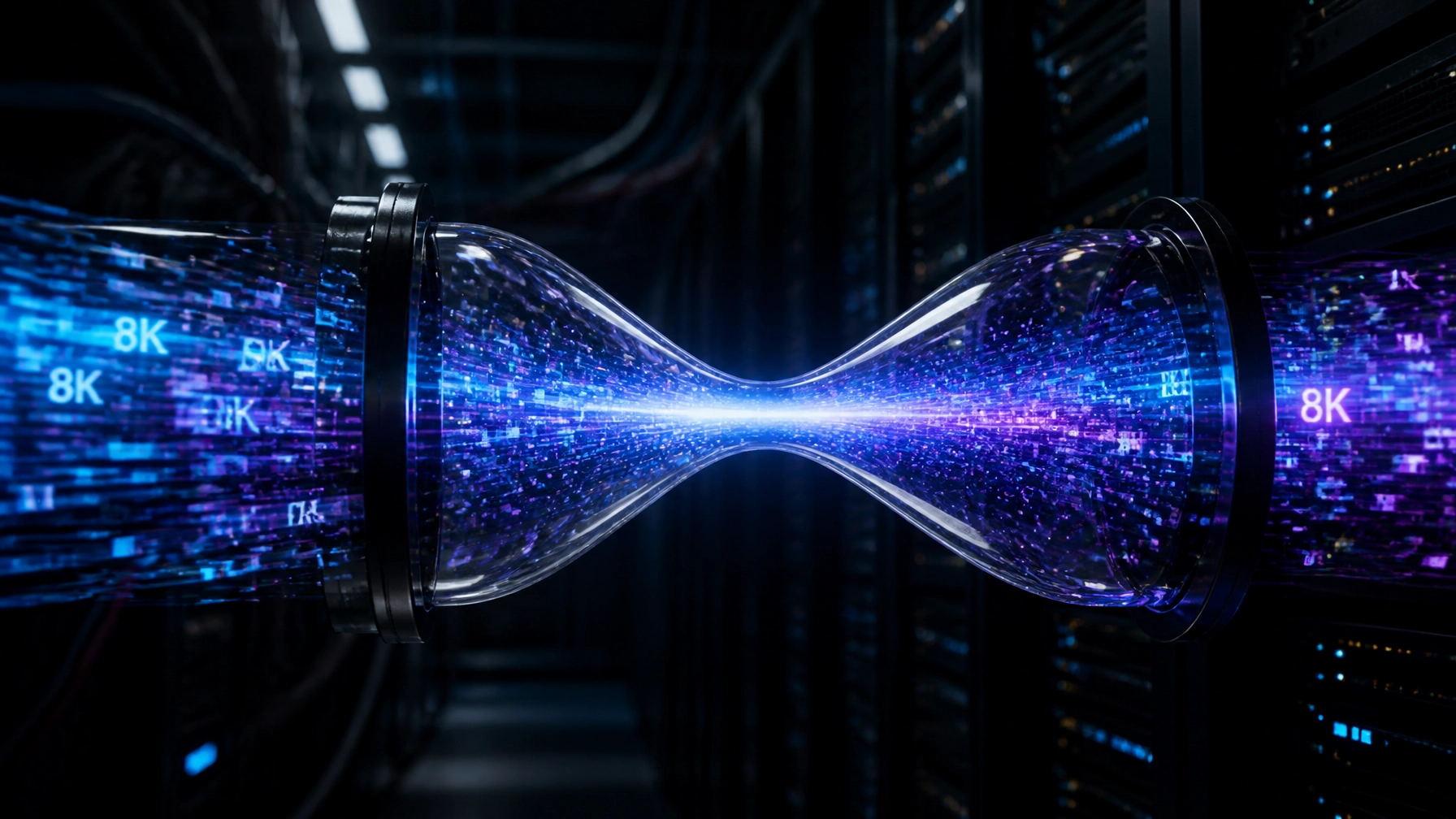
Everyone loves a big number. In the world of displays, "8K" is the biggest number we’ve got right now. It promises four times the detail of 4K and sixteen times the detail of 1080p. It’s the "holy grail" of immersion.
But here’s the cold, hard truth: for most of the world, 8K is currently a pipe dream.
While TV manufacturers are busy pushing 8K panels into every big-box store, the infrastructure that actually carries that video: the "pipes": is screaming for mercy. At the Data Transmission Efficiency Alliance (DTEA), we look past the marketing hype at the raw math of data transmission. And right now, the math doesn't look great for the average consumer.
The Brutal Math of 8K
To understand why 8K is such a headache, you have to look at the sheer volume of data involved. An 8K frame contains approximately 33 million pixels. When you’re running that at 60 frames per second (fps) in High Dynamic Range (HDR), you are asking your internet connection to do some serious heavy lifting.

Current 4K streams typically hover around 15–25 Mbps. For a "broadcast-grade" 8K experience using the standard HEVC (H.265) codec, you’re looking at 50 to 100 Mbps per stream.
Think about that for a second. If you have a 100 Mbps fiber connection: which is considered "fast" in many parts of the U.S. and Europe: one person watching an 8K movie effectively kills the bandwidth for the entire house. No Zoom calls, no gaming, no scrolling TikTok in the other room. The pipe is full.
Codecs: Our Only Hope?
If the raw data is the problem, codecs are the solution. We’ve relied on HEVC for years, but it’s reaching its limit. This is where VVC (Versatile Video Coding or H.266) enters the frame.
Industry leaders like Spin Digital have demonstrated that VVC can slash 8K bitrates down to about 30–50 Mbps without losing that "wow" factor. That’s a massive 30-40% saving over HEVC.
However, VVC isn't a magic wand you can wave tomorrow. It requires:
- New Hardware: Your current smart TV or streaming stick probably doesn't have a VVC decoder chip.
- Massive Compute Power: Encoding 8K in VVC in real-time takes an incredible amount of server power, which means higher costs for streaming services like Netflix or Prime Video.
- Licensing Mess: The industry is still untangling the royalty and licensing web surrounding VVC, which slows down adoption.
Until VVC becomes the global standard, 8K will remain an expensive, bandwidth-hungry niche.
The Infrastructure Bottleneck: The "Last Mile" Problem
Even if we perfected the codecs, we still have to get the data to your living room. This is known as the "Last Mile" problem.

While 5G and Fiber-to-the-Home (FTTH) are expanding, they are not universal. A stable, sustained 100 Mbps connection is a luxury. In many regions, network congestion during peak hours (the "Netflix rush hour") causes bitrates to plummet. If your 8K stream drops to 20 Mbps because the neighborhood is busy, it’s no longer an 8K stream: it’s just a blurry mess upscaled by your TV.
Furthermore, the cost of moving this much data is astronomical. For a streaming service, delivering 8K means paying CDNs (Content Delivery Networks) significantly more in egress fees. According to recent infrastructure guides, CDN delivery for 8K requires edge servers with 100 Gbps+ interfaces and massive caching capacity.
Most companies simply aren't ready to pay 4x the delivery cost for a resolution that only 1% of their audience can actually see.
Is 8K Actually Sustainable?
We also need to talk about the elephant in the server room: energy.
More data equals more electricity. More electricity equals a larger carbon footprint. In an era where ESG (Environmental, Social, and Governance) goals are becoming mandatory for big tech, 8K is a hard sell.

Transmitting 8K video at scale could potentially double the energy consumption of data centers involved in video delivery. At the Data Transmission Efficiency Alliance, we believe the industry needs to prioritize efficiency over raw resolution. If we can’t deliver 8K sustainably, should we be delivering it at all?
Why "Good Enough" 4K is Winning
For the average viewer sitting 10 feet away from a 65-inch TV, the visual difference between a high-bitrate 4K stream and a medium-bitrate 8K stream is negligible. Human biology is the ultimate bottleneck. Unless you have a 100-inch screen or you’re sitting three feet away, your eyes simply cannot resolve those extra pixels.
Streaming giants know this. They would rather spend their bits on better color (HDR), higher frame rates (60fps+), and reducing compression artifacts in 4K than chasing the 8K dragon.
The Role of DTEA: Moving Toward a Standard
So, is 8K dead? Not at all. It’s the future for virtual reality, medical imaging, and massive stadium displays. But for your living room, it’s currently on life support provided by marketing departments.
The mission of the Data Transmission Efficiency Alliance (DTEA) is to bridge this gap. We are establishing the first independent certification system for video compression and data transmission.

By setting performance benchmarks, we help companies identify which technologies actually deliver on their promises. Whether it’s a new AI-powered codec or a more efficient CDN protocol, our goal is to ensure that when a company says they are "8K Ready," they aren't just blowing smoke: they are delivering a high-quality, efficient, and sustainable experience.
Conclusion: The Reality Check
8K isn't a pipe dream forever, but it’s a pipe dream for now for the mass market. The technology exists, but the economics and the infrastructure do not.
Until we see a massive rollout of VVC-capable devices and a total overhaul of global broadband stability, 4K will remain the king of the mountain. At DTEA.org, we’re working to make sure that when the pipes are finally ready, the data flowing through them is as efficient as possible.
If you’re a streaming service or a data center looking to optimize your transmission and get ahead of the 8K curve, contact us today to learn more about our certification programs.