We’ve all been there. It’s Sunday night, you’re slumped on the couch, and you’re about to dive into the latest epic sci-fi series in glorious, crystal-clear 4K. It looks incredible. Every pore on the actor's face is visible; every leaf in the background is sharp.
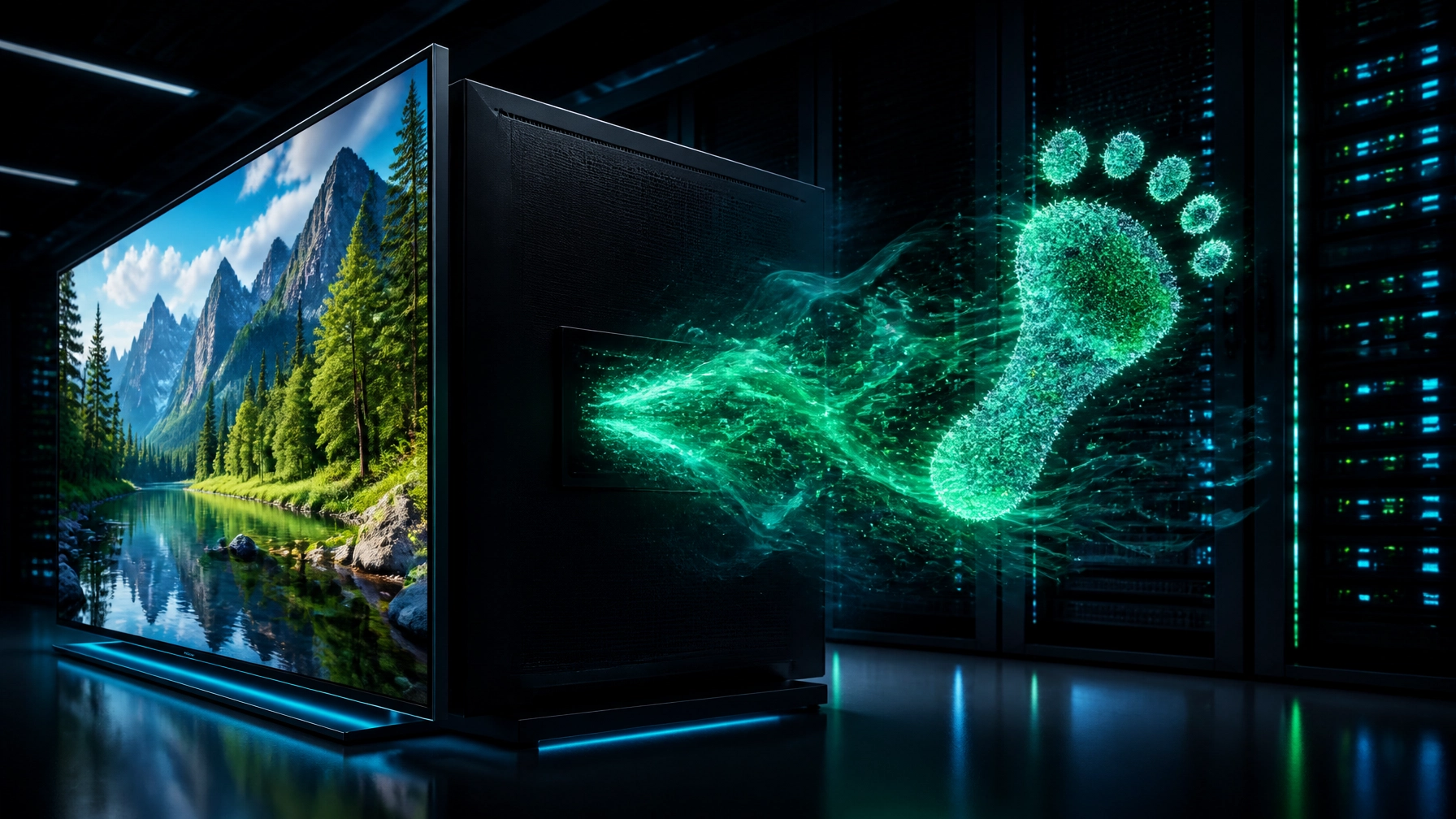
But while you’re marveling at the resolution, there’s a silent, invisible cost adding up. No, I’m not talking about your monthly subscription fee. I’m talking about the carbon footprint of those pixels.
As we push into 2026, our appetite for high-definition data is skyrocketing. But the tech industry is facing a reckoning: how do we keep the world entertained without cooking the planet?
The 4K Obsession: More Pixels, More Power
Let’s get real about the numbers. Streaming a 4K video isn't just "a bit more" than standard definition; it’s a massive jump in data. A typical 4K stream pulls about 15–18 Mb/s. That’s more than double the data of HD and nearly nine times the data of a standard definition stream.
According to recent data from the Carbon Trust, streaming one hour of video in 2026 results in roughly 50 to 100 grams of CO2e. If that doesn't sound like much, multiply it by the billions of people streaming every single day.

The problem isn't just your TV (though your massive 75-inch screen is a major energy hog). The real issue is the entire chain of transmission. Every bit of data has to be stored, processed, and pushed through a complex web of undersea cables, fiber optics, and local routers before it even hits your screen.
The "Invisible Tax" of Data Transmission
For tech leaders at companies like Netflix, Prime Video, or AWS, this isn't just an environmental issue: it’s a business one. Every gigabyte of "waste" in your transmission pipeline is money down the drain.
We call it the "Invisible Tax." It's the cost of inefficient encoding and data transmission that bloats your egress fees and inflates your data center cooling costs.

Data centers and networks now account for roughly 3.3% to 3.8% of global greenhouse gas emissions. Within that, streaming media alone contributes over 1% of global emissions. If we don’t optimize now, experts project that ICT emissions could hit 14% by 2040.
Why "Good Enough" Codecs are Killing Your ESG Goals
Most streaming services rely on "good enough" compression. But in 2026, "good enough" is a liability. If your compression technology is 10% less efficient than it could be, you are essentially paying for 10% more electricity, 10% more storage, and 10% more carbon emissions than necessary.
This is where the Data Transmission Efficiency Alliance (DTEA) comes in.
We realized that the industry was flying blind. There were no independent, third-party benchmarks to tell a CTO which video compression technology was actually the most efficient. Everyone claims their codec is the best, but who is actually verifying it?
The DTEA Solution: Independent Certification
The DTEA is establishing the first independent certification system for video compression and data transmission. We aren't here to sell you a codec; we’re here to set the benchmarks.
Our goal is simple:
- Set Performance Benchmarks: Real-world testing that goes beyond marketing fluff.
- Certify Technologies: Providing a "seal of approval" for technologies that achieve superior efficiency.
- Recognize Leaders: Highlighting the organizations that are actually doing the work to reduce their data transmission footprint.

By achieving a DTEA certification, streaming companies can prove to their stakeholders: and their customers: that they aren't just talking about sustainability; they are building it into their infrastructure.
How to Lower Your Footprint (And Your Bills)
If you're a tech leader looking to get ahead of the curve, here’s how you can start reducing your 4K footprint today:
1. Optimize Your Encoding Ladder
Don't just blast 4K at everyone. Use per-title encoding and context-aware bitrates to ensure you’re only sending the pixels that actually matter for the device being used.
2. Audit Your CDNs
Not all Content Delivery Networks are created equal. Some are significantly more energy-efficient than others. Look for partners who prioritize renewable energy and low-latency, high-efficiency routing.
3. Seek Independent Verification
Stop relying on vendor-provided data. Use independent benchmarks to evaluate your tech stack. This is the only way to ensure you are getting the efficiency you’re paying for.
4. Lean into ESG Metrics
In 2026, your carbon footprint is a metric that investors care about. Reducing your transmission bloat is one of the fastest ways to improve your ESG scores while simultaneously cutting operational costs.
The Bottom Line
Our obsession with high-resolution content isn't going away. 8K is already on the horizon, and VR/AR streaming is set to explode. But the planet can’t afford our inefficiency.
It’s time to stop treating data as a limitless resource. Every bit has a cost. By focusing on transmission efficiency, we can keep the world binge-watching without burning through our future.
Ready to see how your tech stacks up? Join the Data Transmission Efficiency Alliance and help us build a leaner, greener internet.