Video isn't just part of the internet anymore. It is the internet. Current data shows that video accounts for about 80% of all global internet traffic. For streaming giants like Netflix, Prime Video, and Disney+, the challenge has always been simple: How do we get high-quality video to a user's screen without it buffering, lagging, or costing a fortune in bandwidth?
For years, the answer was the Content Delivery Network (CDN). You cache a file in a server near the user, and they download it. Simple. But in 2026, "simple" doesn't cut it. With the rise of 4K/8K streaming, interactive live sports, and cloud gaming, we’ve reached the limit of what traditional "cache-and-serve" models can do.
Enter Edge Computing.
Beyond Caching: The Move to Compute-at-the-Edge
Traditional CDNs act like a local warehouse. They store the goods so they can get to you faster. Edge computing, however, is like having the factory, the kitchen, and the delivery driver all stationed at the end of your street.
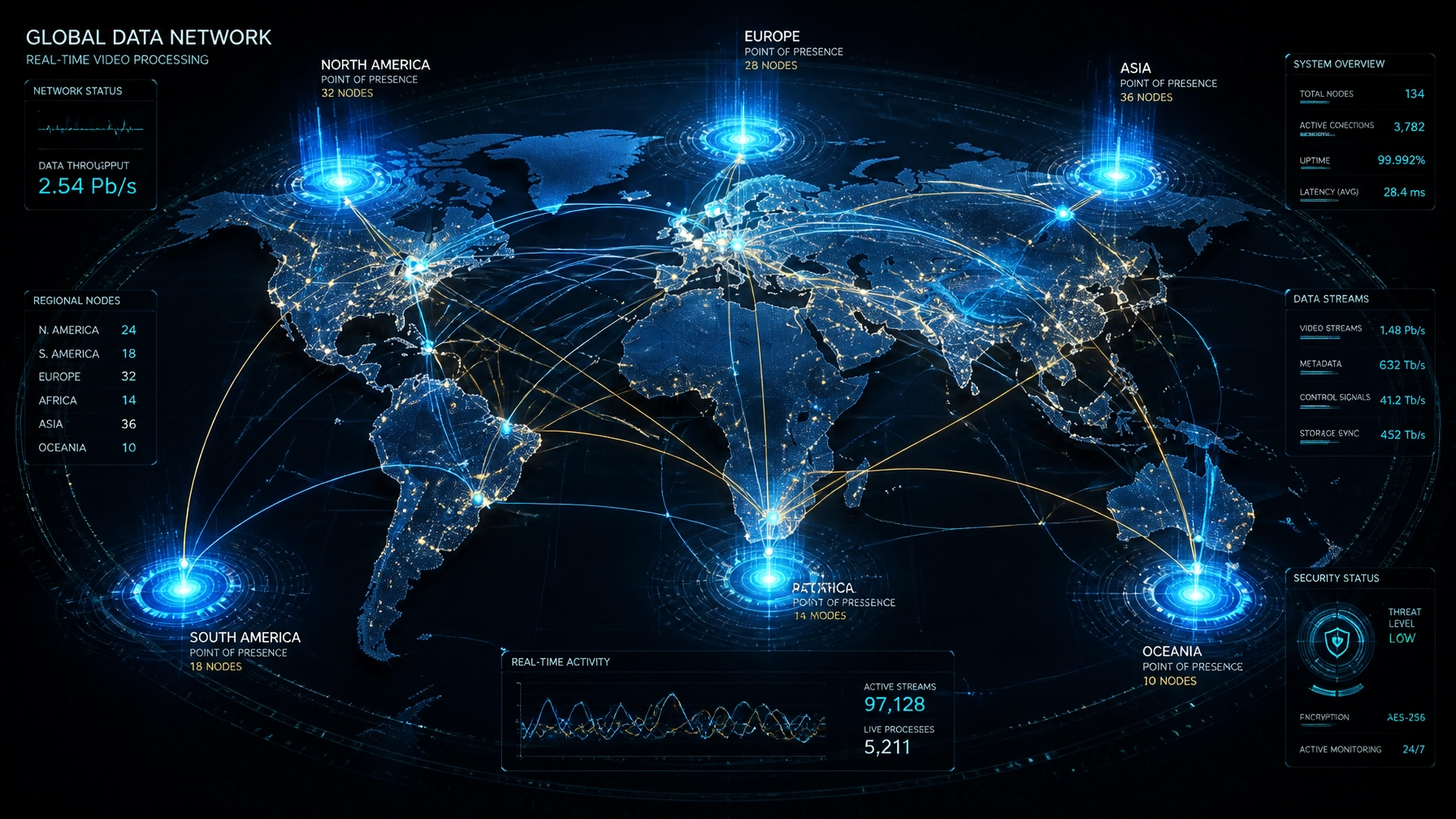
Instead of just storing files, edge computing allows providers to run complex tasks: like encoding, packaging, and AI-driven analytics: at the "edge" of the network, right next to the user. This shift is turning CDNs into "Edge Application Platforms."

1. Killing Latency for Live Events

If you're watching a live football game and your neighbor cheers 30 seconds before you see the goal, the streaming service has failed. This is the "spoiler effect," and it's been the bane of OTT (Over-The-Top) broadcasting for a decade.
By moving the encoding and packaging process to the edge, companies can slash latency from 30+ seconds to sub-second levels. According to Streaming Media, edge-enabled live workflows can reduce delays to under 200ms. This enables "broadcast-grade" speed for live sports, betting, and interactive auctions.
2. Reducing Backbone Congestion
Every time a raw 4K video stream travels from an origin server in Virginia to a viewer in London, it eats up "backbone" bandwidth. It’s expensive and inefficient.
Edge computing allows for just-in-time transcoding. Instead of sending 50 different versions of a video file across the ocean, you send one high-quality "mezzanine" file to the edge. The edge node then creates the specific version needed for the viewer’s device (whether it’s a 5G phone or a 4K TV) locally. This reduces long-haul traffic and significantly lowers egress fees for providers.
3. Personalization at Scale
We live in an era of personalized ads and interactive overlays. In the old model, the central cloud had to decide which ad to show you, package it into the stream, and send it out. This adds round-trip time and complexity.
With edge computing, platforms like Akamai EdgeWorkers allow developers to run "microservices" at the edge. This means ad insertion, watermarking, and even localized graphics happen inches away from the viewer. It’s faster, more relevant, and doesn't bog down the main server.

The "Efficiency" Trap: Why We Need Standards
Here’s the catch: Edge computing is powerful, but it isn’t free. Running compute tasks on thousands of distributed nodes consumes massive amounts of energy and hardware resources. If every streaming service uses its own unoptimized "edge" code, we aren't actually solving the data problem: we're just moving it.
This is exactly why the Data Transmission Efficiency Alliance (DTEA) exists.
As the industry rushes toward the edge, we need a way to measure what "efficient" actually looks like. Is a specific edge-encoding algorithm actually saving data, or is it just wasting CPU cycles? At DTEA, we are establishing the first independent certification system for these technologies.
Benchmarking the Edge
For a streaming company, choosing an edge provider is currently a guessing game based on vendor marketing. Our mission is to set performance benchmarks that answer the hard questions:
- Compression Efficiency: Does the edge node maintain quality while reducing bitrate?
- Transmission Performance: How much energy is consumed per gigabyte delivered?
- Latency Accuracy: Are the sub-second claims actually true under heavy load?
By achieving DTEA certification, organizations can prove they aren't just "at the edge," but that they are delivering data in the most efficient way possible.

The Role of 5G and Mobile Edge (MEC)

The impact of edge computing is most visible in the mobile world. 5G networks are designed to work hand-in-hand with Multi-access Edge Computing (MEC). Platforms like AWS Wavelength embed AWS compute and storage services within 5G networks.
This means that for a user on a mobile device, the "edge" is literally the cell tower they are connected to. For applications like VR/AR streaming or cloud gaming, this proximity is the difference between a seamless experience and a nauseating lag.
Filtering the Noise: The Future of Data Storage
As we move toward 2027, the "funnel" of data needs to get tighter. We cannot continue to store and transmit every pixel of raw data generated by billions of cameras and devices.
Edge nodes will increasingly act as "intelligent filters." They will use AI to analyze video feeds at the point of capture, extracting only the necessary information or compressing the footage before it ever hits the long-haul network. This "Edge AI" will be the next frontier in transmission efficiency.

Summary: Efficiency is the New Currency
The shift to edge computing is inevitable. It solves the physics problem of latency and the economic problem of backbone costs. But as we distribute our "factories" to the edge of the world, we must remain obsessed with efficiency.
At DTEA, we believe that the future of global video delivery isn't just about being closer to the user: it's about being smarter with the data we send. Whether you are a streaming giant or a data center operator, efficiency is no longer optional. It is the only way to scale.