Every time you hit "play" on a streaming service, a complex chain of events triggers in a data center halfway across the world. The video file is compressed, transmitted, and decompressed in real-time. While we often focus on the quality of the 4K stream or the speed of the connection, there is a silent battle happening in the server racks: the battle between Software Encoding and Hardware Encoding.
As global data traffic explodes: driven largely by video: the energy consumption of these processes has become a critical concern for sustainability and operational costs. At the Data Transmission Efficiency Alliance (DTEA), we are setting the benchmarks to quantify exactly how much energy these technologies consume.
Is a general-purpose CPU "good enough," or is dedicated hardware the only way to save our power grids? Let’s look at the data.
The Software Paradox: Versatility vs. Waste
Software encoding relies on a Central Processing Unit (CPU). It uses applications like x264 or x265 to process video frames using general-purpose instructions.
The beauty of software encoding is its flexibility. If a new codec version drops tomorrow, you just update the software. You can tune every tiny parameter to squeeze the highest possible visual quality out of every bit. For years, this was the gold standard for high-end streaming.
However, that flexibility comes with a massive "energy tax."
Why CPUs Are Power Hungry
A CPU is a "Jack of all trades." When it encodes video, it spends a significant amount of energy on overhead that has nothing to do with compression. It has to fetch instructions, decode them, manage complex branch predictions, and move data across large, power-intensive caches.
Research shows that running a high-quality software encoder on a modern CPU can add 30W to 80W of extra power draw per stream. In a data center with thousands of concurrent streams, those watts add up to megawatts of wasted energy.

Hardware Encoders: The Specialized Force
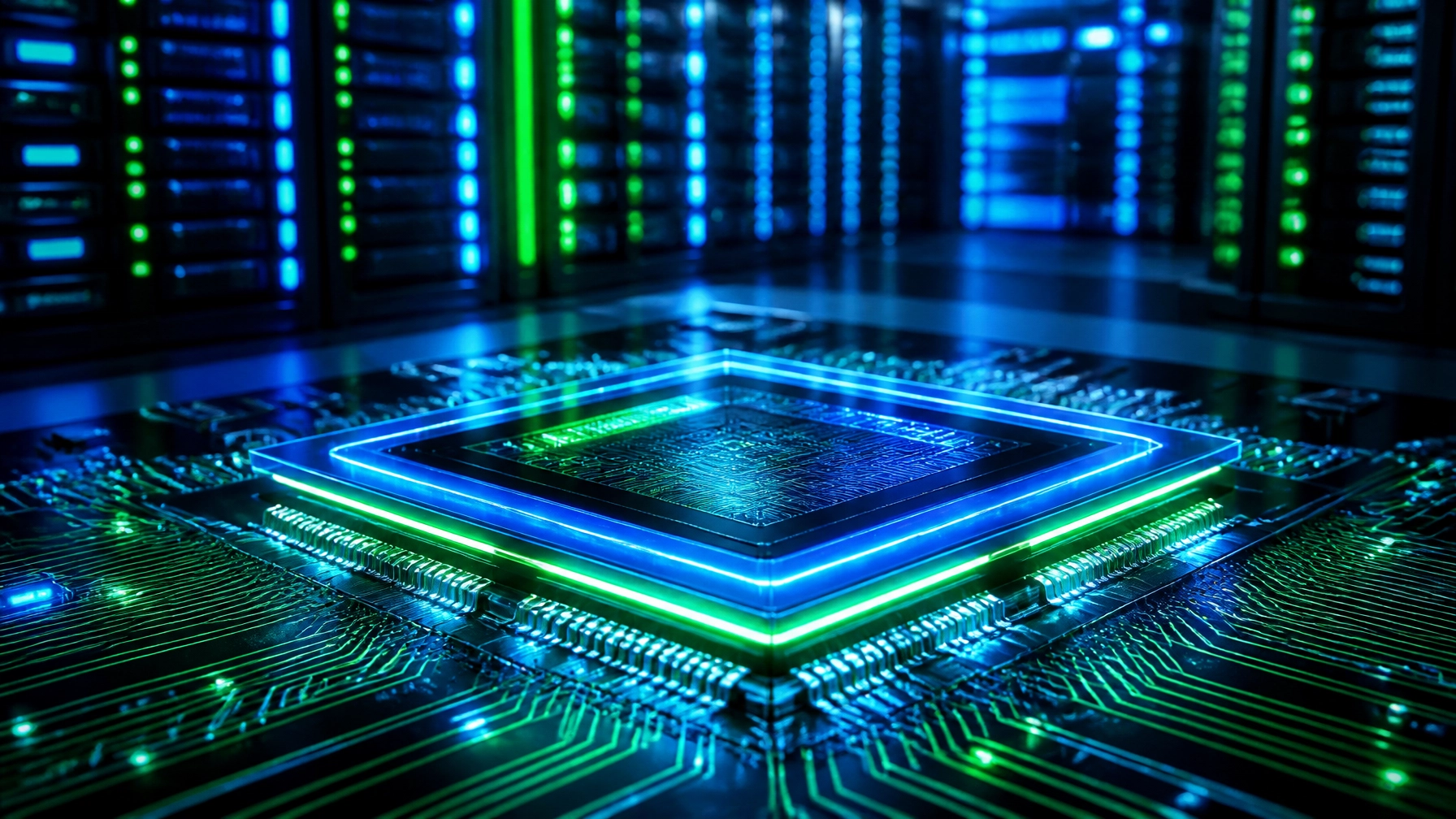
Hardware encoding happens on dedicated silicon blocks. These can be part of a Graphics Processing Unit (GPU) like NVIDIA’s NVENC or Intel’s QuickSync, or they can be entirely separate Application-Specific Integrated Circuits (ASICs).
Unlike a CPU, an ASIC is built for one job and one job only: video compression.
The Efficiency Edge
Because the hardware is "hardwired" for the math involved in video encoding: like motion estimation and discrete cosine transforms: it doesn't need to waste energy on general-purpose instructions.
- No Instruction Overhead: The silicon only performs codec-specific tasks.
- Deep Pipelining: It processes data in a streamlined flow, allowing it to run at lower clock speeds while maintaining high throughput.
- Localized Memory: It keeps data close to the processing units, avoiding the power drain of reaching out to system RAM or massive L3 caches.
The result? While a CPU might pull 50W for a 1080p stream, a dedicated hardware block often does the same work for less than 5W.
The 10x-100x Efficiency Gap
The difference isn't just incremental; it is an order of magnitude. Recent studies, including those archived on arXiv, suggest that hardware-based video processing can reduce dynamic energy consumption to less than 10% of what an optimized software decoder uses.
When you look at the architecture, a hardware encoder can be up to 22 times more efficient than a software encoder using SIMD (Single Instruction, Multiple Data) optimizations. If compared to non-optimized software, the gap can jump to 100 times.
For a mobile device, this is the difference between your phone lasting through a long flight or dying before the first movie ends. For a data center, it’s the difference between a profitable operation and one drowned by electricity bills.
Data Center Economics: Cooling and ESG
For streaming giants like Netflix, Prime Video, and AWS, the "power saved" is about more than just the electricity bill. It's about density and cooling.
The Heat Problem
Every watt of power consumed by a CPU is eventually released as heat. In a packed server rack, that heat must be removed by massive cooling systems. Cooling accounts for a huge portion of a data center’s Power Usage Effectiveness (PUE) ratio.
By switching to ASIC-based transcoders, data centers can pack more "channels per rack-watt." Instead of four high-powered servers running CPU encoding, a single server with a dedicated ASIC card can often handle the same load with a fraction of the thermal output.
Meeting ESG Goals
Environmental, Social, and Governance (ESG) metrics are no longer optional for big tech. Companies are under pressure to report their carbon footprint. Since data centers are responsible for roughly 1-1.5% of global electricity use, optimizing video: which makes up the majority of that traffic: is the "low-hanging fruit" for sustainability.

The Trade-off: Quality vs. Efficiency
The common argument against hardware encoding has always been quality. Historically, software encoders could produce a better-looking image at a lower bitrate because they could afford to be computationally "expensive."
However, that gap is closing fast. Modern hardware encoders (like those found in the latest AV1-capable GPUs and ASICs) now rival software quality in most real-world scenarios. For 99% of viewers, the difference is invisible, but the energy savings are very real.
Why Independent Benchmarks are Vital
The industry is currently filled with conflicting claims. Vendor A says their hardware is the fastest. Vendor B says their software is the greenest. Without an independent third party, how do streaming companies know what to buy?
This is why the DTEA exists. We are establishing the first independent certification system for video compression and data transmission. We don't just look at "frames per second"; we look at Quality per Watt.
Our mission is to:
- Set Performance Benchmarks: Create standardized tests that measure real-world energy consumption alongside visual quality.
- Certify Technologies: Provide a "seal of approval" for hardware and software that meets high-efficiency standards.
- Recognize Leaders: Highlight the organizations that are actually moving the needle on data transmission efficiency.
Conclusion: Choosing for the Planet
The choice between hardware and software encoding isn't just a technical one: it's a business and environmental one. Software still has its place in research and ultra-high-end archival encoding. But for the massive, everyday scale of global streaming, hardware is the clear winner for the planet.
As we move toward a future of 8K video, VR, and AI-driven content, we cannot afford to use "general-purpose" energy for "specific-purpose" tasks. It's time to demand better efficiency.
Are you building the next generation of streaming? Check out our efficiency standards and join the alliance to help make data transmission sustainable.