Most people think of video as just "the video file." If it’s an .mp4, it works. If it’s an .mkv, maybe it doesn’t. But in the world of professional streaming, where Netflix, Prime Video, and YouTube operate, the "container" or "package" holding that video data is just as important as the video itself.
At the Data Transmission Efficiency Alliance (DTEA), we focus on the bits that move across the wire. While codecs like AV1 and HEVC do the heavy lifting of shrinking the video frames, the container (the "wrapper") determines how that data is delivered, how much extra "overhead" is added, and how fast a user can start watching.
If you’re still using legacy packaging methods, you’re likely wasting bandwidth and storage. Let’s break down why the classic .mp4 isn't always the efficiency king and what you should use instead.
What is a Video Container, Anyway?
Think of a video container like a shipping box. The "payload" inside is your video and audio data. The "container" is the box itself, along with the packing peanuts, the shipping label, and the manifest inside that tells you what’s in the box.
"Container overhead" is the extra data used to manage that box. It includes:
- Headers: Metadata about the file.
- Indices: Tables that tell the player where specific frames are located.
- Timestamps: Ensuring audio and video stay in sync.
- Encryption Info: If the content is protected by DRM.
While this overhead usually only accounts for 1% to 3% of the total file size, at the scale of a global streaming service, 1% wasted across a petabyte of data is a massive: and expensive: inefficiency.
The Contenders: Comparing Container Efficiency
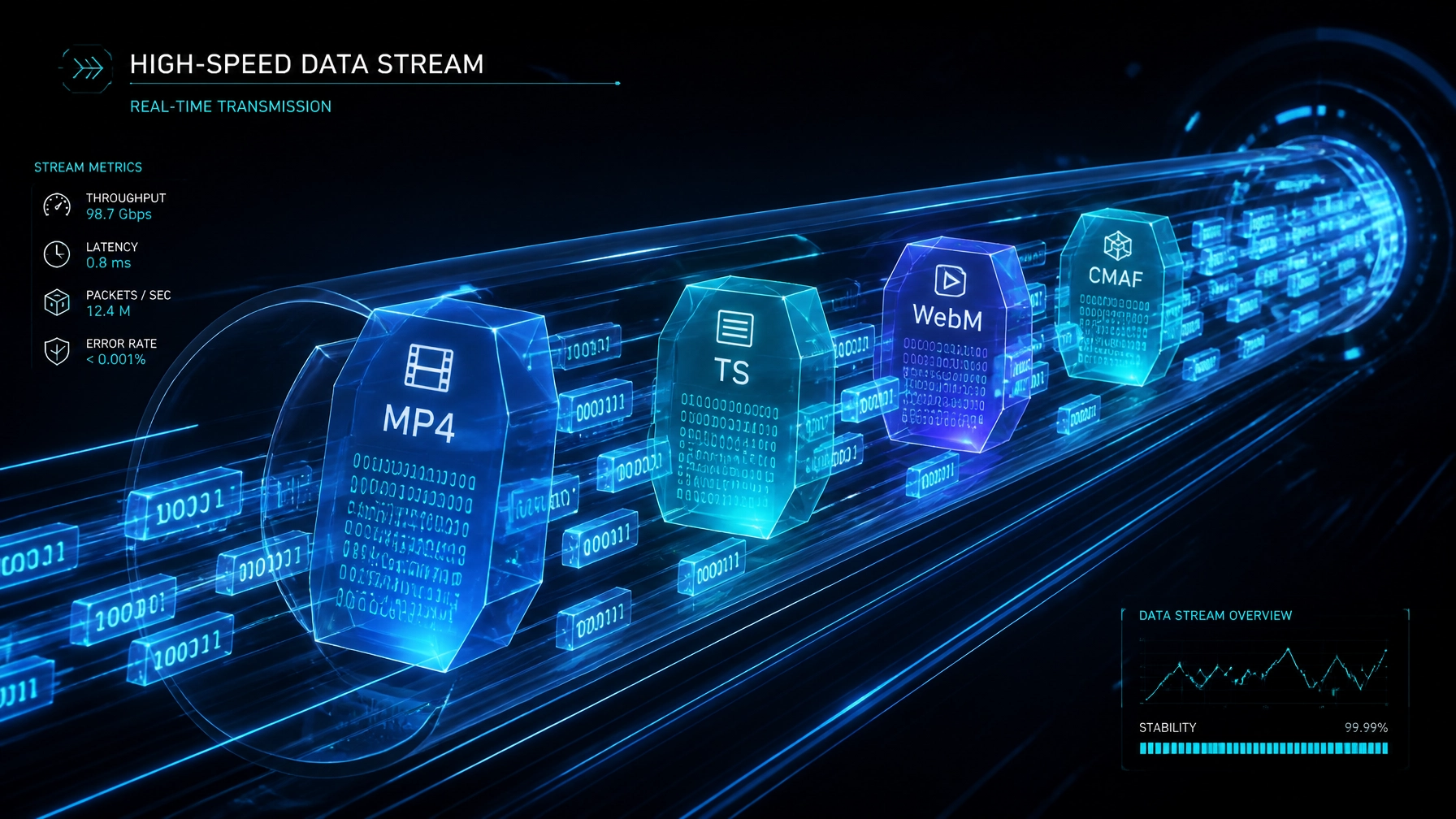
1. The Legacy King: MPEG-TS (.ts)
For a long time, MPEG-TS was the standard for HLS (HTTP Live Streaming). It was designed for broadcast television: environments where data loss is common.
Because it was built for robustness over efficiency, MPEG-TS uses fixed 188-byte packets. Each packet has its own header. This means the container is constantly repeating information so a TV can "tune in" at any moment.
The Efficiency Verdict: MPEG-TS has the highest overhead of all modern containers. In an HTTP world where we have reliable data transmission (TCP), this extra "robustness" is just wasted bandwidth. Most modern services are moving away from .ts for this reason.

2. The Standard: MP4 and Fragmented MP4 (fMP4)
The standard .mp4 (ISO BMFF) is much more efficient than MPEG-TS. It’s a file-oriented container with relatively low overhead. However, a "plain" MP4 is one long file. To stream it adaptively, we use Fragmented MP4 (fMP4).
fMP4 breaks the video into small "fragments" or "segments." This allows the player to request only the pieces it needs.
- Overhead: Much lower than MPEG-TS.
- Efficiency: Excellent for VOD (Video on Demand).
3. The Lean Alternative: WebM (Matroska)
WebM is based on the Matroska (.mkv) container. It’s primarily used by Google (YouTube) with the VP9 or AV1 codecs.
- The Efficiency Verdict: Purely at the container level, WebM/Matroska often has the lowest muxing overhead. It’s incredibly lean. However, its adoption is lower in the Apple ecosystem compared to MP4-based formats.
4. The Efficiency Champion: CMAF
CMAF (Common Media Application Format) isn't exactly a "new" container; it's a standardized profile of fMP4. Before CMAF, streaming services often had to package the same video twice: once in MPEG-TS for Apple devices (HLS) and once in fMP4 for everyone else (DASH).
CMAF allows a single set of fMP4 segments to work for both HLS and DASH.
The Efficiency Verdict: While the per-byte overhead is similar to fMP4, CMAF's real efficiency comes from halving your storage costs and simplifying your CDN caching. You only store and cache one version of the video instead of two.

Why eMPEG is the Future of Efficient Packaging
eMPEG (Enhanced MPEG, also called Efficient MPEG in some technical discussions) builds on the same core idea that made CMAF valuable: cut duplication, reduce overhead, and move fewer bits for the same stream. The difference is that eMPEG pushes packaging efficiency one step further.
Lower Container Overhead Than Traditional MP4 and fMP4
Traditional MP4 and fMP4 workflows still carry repeated box structures, fragment metadata, indexing information, and timeline signaling in every segment. That overhead is small on a single asset, but it adds up fast across millions of sessions.
eMPEG is designed to reduce that packaging tax by minimizing repeated container metadata and making segment signaling more compact. In practical streaming workflows, that can trim container overhead by roughly 20% to 50% versus standard fMP4 packaging, depending on segment length, track layout, encryption, and how much per-fragment metadata is being repeated.
On a full video stream, that usually translates into a more modest but still meaningful 0.5% to 2% total bitrate reduction without changing the video codec itself. That sounds small, but at scale it matters.
For example:
- A 6 Mbps stream reduced by 1% saves 60 Kbps per viewer.
- Across 1 million concurrent viewers, that is 60 Gbps less traffic.
- Over one hour, that equals about 27 TB of data avoided.
That is packaging efficiency turning directly into network efficiency.
Better for Multi-Codec Streaming
Modern platforms rarely run one codec. They often package the same title in AV1, HEVC, and increasingly VVC to match different device capabilities.
That creates a workflow problem. Every codec ladder needs its own segments, metadata, manifests, DRM signaling, and cache behavior. Standard packaging works, but it is not optimized for this level of duplication.
eMPEG is attractive because it is better suited to multi-codec packaging at scale:
- It reduces repeated structural metadata across parallel codec variants.
- It simplifies packaging logic for services maintaining AV1, HEVC, and VVC ladders side by side.
- It improves cache efficiency when platforms need to serve many device-specific representations from one content pipeline.
- It helps preserve the codec gains you already paid for, instead of giving some of them back in container overhead.
If AV1 cuts bitrate by 20% to 30% versus older codecs, it makes little sense to keep wasting extra bits in the wrapper. eMPEG helps close that gap.
Lower Egress Cost Per Stream
For large streaming platforms, small bitrate savings create large financial savings because CDN and cloud egress pricing scale with every delivered gigabyte.
Take a platform delivering a stream at 5 Mbps. If eMPEG reduces total delivered bitrate by even 1%, that drops the stream to 4.95 Mbps. That is only 50 Kbps saved per stream, but at scale it becomes serious money.
At 10 million stream-hours, a 1% reduction on a 5 Mbps service avoids roughly 22.5 petabytes of data transfer. For companies operating at the scale of Netflix or Prime Video, even conservative egress rates turn that into a meaningful cost reduction. It also lowers backbone load, CDN cache fill traffic, and origin stress.
This is why packaging is no longer just an implementation detail. It is part of the economics of streaming.
The Next Logical Step After CMAF
CMAF solved a major efficiency problem by unifying HLS and DASH around one segment format. That was a huge improvement. But CMAF still inherits much of the traditional ISO BMFF fragmentation model.
eMPEG is the next logical step because it asks a more aggressive question: if we already unified delivery, how much more waste can we remove from the package itself?
That matters most in workflows where:
- segment counts are high
- latency targets are tight
- codec ladders are wide
- DRM signaling is complex
- traffic volumes are massive
In those environments, shaving even 1% to 2% off delivered bitrate is not a rounding error. It is a measurable transmission gain.
At DTEA, we see eMPEG as a strong direction for the next wave of packaging benchmarks because it aligns with the core goal of efficient data transmission: less wrapper, more payload, lower cost.
The Hidden Cost: Manifest Overhead
When you stream video, your player doesn't just grab a file. It first downloads a "manifest" or "playlist" (like an .m3u8 or .mpd file). This file tells the player where all the segments are.
If you use very short segments (e.g., 1-second chunks) to achieve low latency, the manifest file can grow quite large. The player has to reload this manifest constantly. For a user on a weak mobile connection, the "manifest overhead" can actually start to eat into the bandwidth available for the actual video.
At DTEA, we recommend a balance. Using 2–4 second segments usually provides the best trade-off between start-up time (latency) and transmission efficiency.

Impact on Start-up Time and UX
Packaging choices don't just affect your AWS bill; they affect your customers.
- MPEG-TS can lead to slower start-up times because the player has to parse more header data before it can start decoding.
- CMAF with "Chunked Transfer" allows the player to start playing a segment before it has finished downloading the whole segment. This is the gold standard for low-latency live streaming.
Choosing the Right Package for Efficiency
If you want to optimize your data transmission, here is the DTEA-approved hierarchy:
- Use CMAF (fMP4) whenever possible. It’s the most efficient way to reach the widest audience with the least amount of storage and overhead.
- Avoid MPEG-TS unless you absolutely must support legacy hardware or specific broadcast workflows.
- Optimize your segment length. Don't go too short (which bloats the manifest) or too long (which hurts seek times and start-up speed). 2-4 seconds is the "sweet spot."
- Use DASH Segment Templates. In your manifest files, use templates rather than listing every single segment URL. This keeps the manifest file tiny and efficient.
Join the Efficiency Alliance
At the Data Transmission Efficiency Alliance, we are setting the benchmarks for the next generation of video delivery. We believe that efficiency shouldn't be an afterthought: it should be certified.
Whether you are a streaming giant or a growing data center, understanding the nuances of video packaging is the first step toward a more sustainable and cost-effective streaming future. Check out our latest benchmarks and certification standards to see how your tech stacks up.