We’ve all seen the marketing. Glossy 8K displays at CES, promises of "unrivaled immersion," and the claim that 4K is already a relic of the past. It sounds great on a showroom floor. But when you step behind the curtain and look at the actual data transmission plumbing required to make 8K a reality for the average consumer, things get ugly. Fast.
At the Data Transmission Efficiency Alliance (DTEA), we spend our time looking at the numbers that most streaming companies would rather ignore. The cold truth? 8K isn’t just a "little bit" more demanding than 4K. It’s a bandwidth-devouring monster that threatens to break the internet as we know it.
Is 8K a pipe dream? Let’s look at the math, the money, and the technical hurdles that stand in the way.
The Bandwidth Beast: 4K vs. 8K
Let’s start with the basics. 8K resolution (7680×4320) isn’t double the pixels of 4K; it’s four times the pixels. If you’re coming from 1080p, you’re looking at sixteen times the data.
In a world where many households still struggle to maintain a consistent 25 Mbps for a single 4K Netflix stream, 8K is asking for a massive leap.
- Current 4K streaming: Usually requires ~16–25 Mbps.
- Current 8K streaming: Realistically needs 80–100+ Mbps for a stable, high-quality experience.

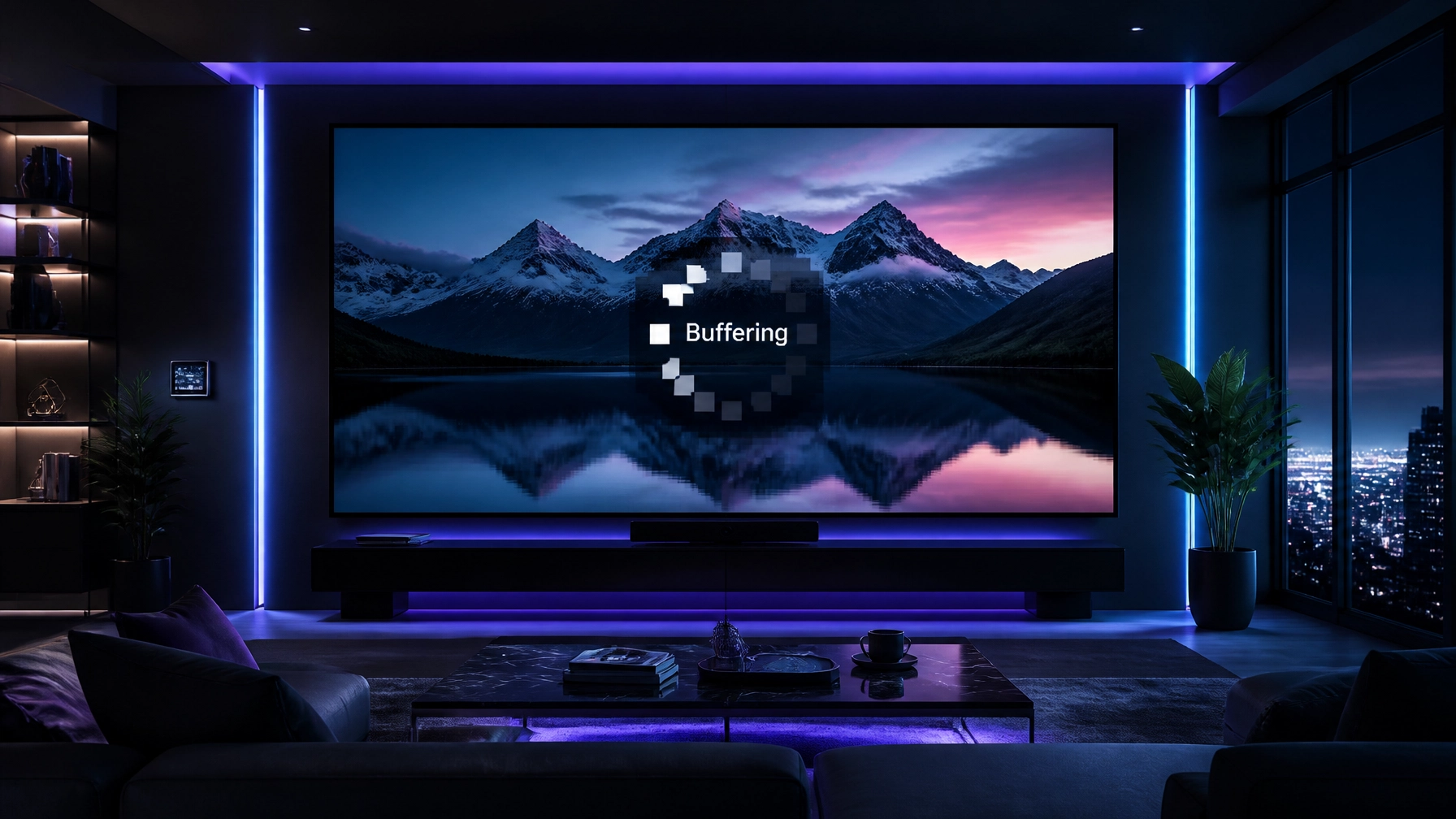
If you have a family where two people are watching 8K in different rooms while someone else plays a cloud-based game, you’re suddenly knocking on the door of 300 Mbps just for entertainment. While gigabit fiber is expanding, the "last mile" of infrastructure, the copper wires and aging Wi-Fi routers in most homes, simply can't sustain that kind of throughput without massive packet loss and the dreaded "buffering" wheel.
The Codec Conundrum: Can VVC Save Us?
The industry’s big hope for 8K is a new codec called Versatile Video Coding (VVC), also known as H.266. Research from groups like the Fraunhofer HHI and Bitmovin suggests that VVC can be up to 40-50% more efficient than the current standard, HEVC (H.265).
In theory, VVC could bring that 100 Mbps requirement down to a more manageable 40-60 Mbps. But there is no such thing as a free lunch in physics or computer science.
The Compute Tax
VVC’s efficiency comes at a staggering computational cost. Encoding 8K video in VVC requires massive amounts of server power. We’re talking about a process that is significantly more complex than HEVC. For a data center, this means:
- More Servers: You need more "iron" to encode the same amount of content.
- More Heat: The energy required to crunch these numbers is immense.
- More Latency: Real-time 8K encoding for live sports is still a technical nightmare.

At DTEA, we advocate for a more balanced approach. Before we push for higher resolutions, we need to certify that the transmission technologies are actually efficient enough to be sustainable. You can learn more about our mission on our About Page.
The Hidden Bill: Egress and Storage
For streaming giants like Netflix, Amazon Prime, and Disney+, 8K isn't just a technical challenge, it's a financial one. The two biggest "invisible" costs in streaming are storage and egress fees.
Storage Explosion
An 8K video file isn't just large; it’s astronomical. A single hour of heavily compressed 8K streaming video takes up about 35 GB. If you’re a studio keeping "mezzanine" files (high-quality masters), you’re looking at terabytes per hour. Storing an entire library in 8K across multiple global data centers adds a massive line item to the infrastructure budget.
The Egress Trap
Cloud providers charge companies for every gigabyte of data that leaves their servers, this is called an egress fee.
If 1,000 people stream an 8K movie at 80 Mbps, the streaming company is moving roughly 34 terabytes of data per hour. At standard cloud rates, that single hour of streaming could cost the provider over $1,700 in bandwidth alone.
Multiply that by millions of viewers, and you can see why 8K makes the bean counters at major streaming services very nervous.

The Reality Check: Can You Even See It?
Here is the most provocative question in the 8K debate: Does it even matter?
The human eye has a "retinal resolution" limit. On a standard 65-inch TV, to actually see the difference between 4K and 8K, you would need to sit about three feet away from the screen. Most people sit 8 to 10 feet away. At that distance, the extra 24 million pixels are essentially invisible to the human brain.
We are entering an era of diminishing returns. We are spending billions of dollars on infrastructure, burning megawatts of power, and clogging up the airwaves with data that the human eye can't even process.
The Path Forward: Why Certification Matters
So, is 8K a pipe dream? In its current state, mostly, yes. For it to become a viable reality, the industry needs more than just bigger screens. It needs a radical focus on transmission efficiency.
This is why the Data Transmission Efficiency Alliance exists. We believe that before a company claims to be "8K ready," they should be able to prove that their technology is efficient. We are establishing the first independent certification system for video compression.
Our goal is to set performance benchmarks that recognize organizations achieving superior efficiency. If a company can deliver 8K at 30 Mbps with zero quality loss, that’s a breakthrough worth certifying. If they’re just throwing more bandwidth at a poorly optimized codec, they’re part of the problem.
How We Help the Industry:
- Benchmarks: Setting the standard for what "efficient" actually looks like.
- Certification: Providing a seal of approval for technologies that reduce the data burden on the planet.
- Transparency: Helping streaming services and data centers understand their true efficiency metrics.
Conclusion
8K is a beautiful vision, but without massive leaps in compression and a serious look at the economic reality of data transmission, it will remain a niche product for the ultra-wealthy.
The industry needs to stop chasing "more pixels" and start chasing "better pixels." Until we can transmit data more efficiently, 8K will continue to be a "pipe dream" that the current pipes simply can't handle.
Ready to see how your organization stacks up? Visit DTEA.org to join the alliance and help us build a more efficient digital future.