If you’re running a streaming platform or a data center in 2026, you’re constantly fighting a two-front war: video quality versus energy costs. As 4K becomes the baseline and 8K looms on the horizon, the amount of data we’re pushing is staggering.
But here’s the kicker: how you process that data determines whether your electricity bill is a manageable line item or a total disaster.
The industry usually splits the world into two camps: Software Encoding (running on general-purpose CPUs like Intel Xeons or AMD EPYCs) and Hardware Encoding (using specialized chips like NVIDIA GPUs or dedicated ASICs).
We’re breaking down the technical differences and, more importantly, the power consumption reality.
The Generalist: Software Encoding (CPU)
Software encoding is the old-school, reliable workhorse. When you use encoders like x264, x265, or AV1 on a standard server CPU, you’re using "general-purpose" logic.
Why people love it:
- Flexibility: You can update your codec with a simple software patch.
- Maximum Quality: If you give a CPU enough time (slow presets), it will produce the most bitrate-efficient file possible.
The Power Problem:
The issue is that CPUs aren't built specifically for the math involved in video compression. They spend a lot of energy on "overhead": things like instruction fetching and context switching.
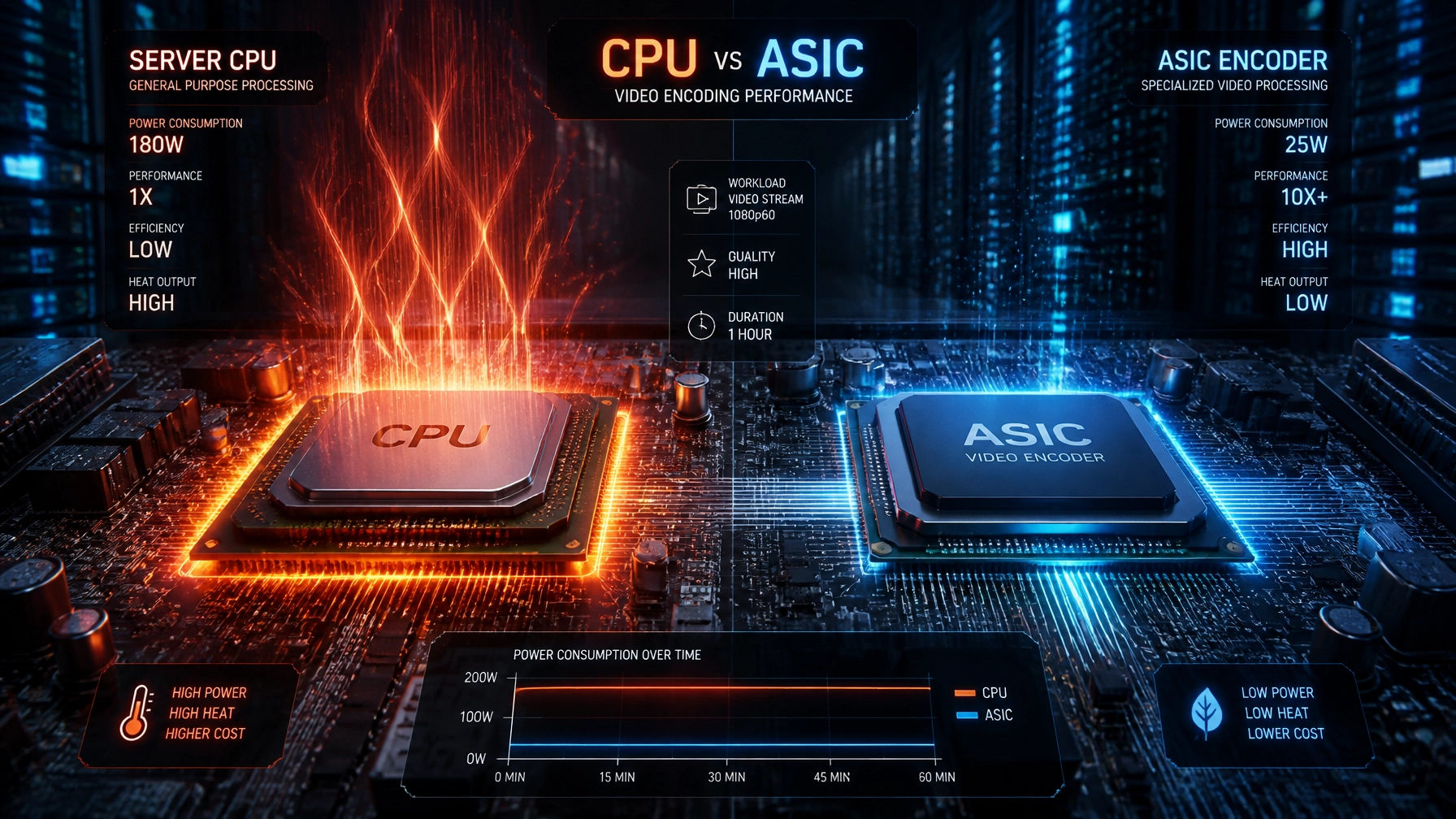
In a recent study, researchers found that high-end CPUs like the Ryzen 9 or server-grade Xeons often consume double the total system power compared to hardware encoders when trying to maintain real-time 4K quality. To keep up with live streams, CPUs have to use "faster" presets, which drops the quality and defeats the purpose of using a CPU in the first place.

The Specialist: Hardware Encoding (GPU & ASIC)
Hardware encoding uses "fixed-function" logic. These are physical circuits etched into a chip that do exactly one thing: process video.
GPU Encoders (NVENC / QuickSync)
Modern GPUs from NVIDIA and Intel have dedicated blocks (like NVENC) that handle encoding without touching the main graphics cores.
- Efficiency Gain: These are typically 2x to 5x more power-efficient per stream than a CPU.
- Real-World Use: Great for game streaming or medium-sized live platforms where you need a balance of speed and power. Tech reviews from Chips and Cheese show that modern hardware encoders are now catching up to software in terms of visual quality.
Dedicated ASICs (The Efficiency Kings)
Then there are ASICs (Application-Specific Integrated Circuits), like the VPUs from NETINT. These aren't even GPUs: they are cards built exclusively for video.
Because they don't have the overhead of a general-purpose processor, they can achieve incredible density. We’re talking about sub-watt to low-single-digit watts per 1080p stream. Compared to a CPU, an ASIC can be 10x more power-efficient.

Breaking Down the Math: Watts Per Stream
When we talk about efficiency at the Data Transmission Efficiency Alliance (DTEA), we look at the Watts per Stream (W/S) or Frames per Watt.
| Encoder Type | Typical Role | Power Efficiency (Relative) |
|---|---|---|
| CPU (Software) | Archival, High-end VOD | Base (1x) |
| GPU (NVENC) | Live Streaming, Gaming | 2x – 5x Better |
| ASIC (VPU) | Mass-scale Live, CDNs | 5x – 10x+ Better |
For a data center, this isn't just about the power going into the chip. It’s about the cooling. Every extra watt spent on a thirsty CPU generates heat that requires more power to remove. By switching to high-density ASIC hardware, a streaming service can theoretically slash their rack space and cooling costs by 80% or more.
The "Quality Trap"
If hardware is so much more efficient, why doesn't everyone switch tomorrow?
Historically, hardware encoders were seen as "fast but ugly." They produced blocky video compared to the pristine output of a slow software encoder. However, in 2026, that gap has narrowed significantly. For 99% of viewers watching on a smartphone or a 4K TV, the difference between a high-quality hardware encode and a software encode is invisible.
The trade-off is now clear: Is a 2% gain in compression efficiency worth a 500% increase in power costs? For most streaming giants, the answer is a hard "No."
Why Independent Certification Matters
The problem today is that every vendor claims they are the "most efficient." But "efficiency" is a moving target. It depends on the codec (H.264 vs AV1), the resolution, and the target bitrate.
That is why we founded the Data Transmission Efficiency Alliance. We are building the first independent certification system to set real benchmarks. We don't care if it's a CPU, a GPU, or a specialized chip: we care about how much data you can move per watt without sacrificing the user experience.

The Bottom Line
If you are running a small-scale operation where quality is the only metric that matters, Software Encoding on a CPU still has its place.
But for anyone operating at scale: Netflix, Prime Video, or global CDNs: the future is undeniably Hardware. The power savings are too massive to ignore, especially as energy prices and ESG (Environmental, Social, and Governance) requirements become a core part of business operations.
Specialized ASICs aren't just a "nice to have" anymore; they are the only way to keep the streaming industry sustainable.
Are you ready to see how your tech stacks up? Check out our latest initiatives at DTEA.org and join the alliance to help set the standard for a greener, faster internet.