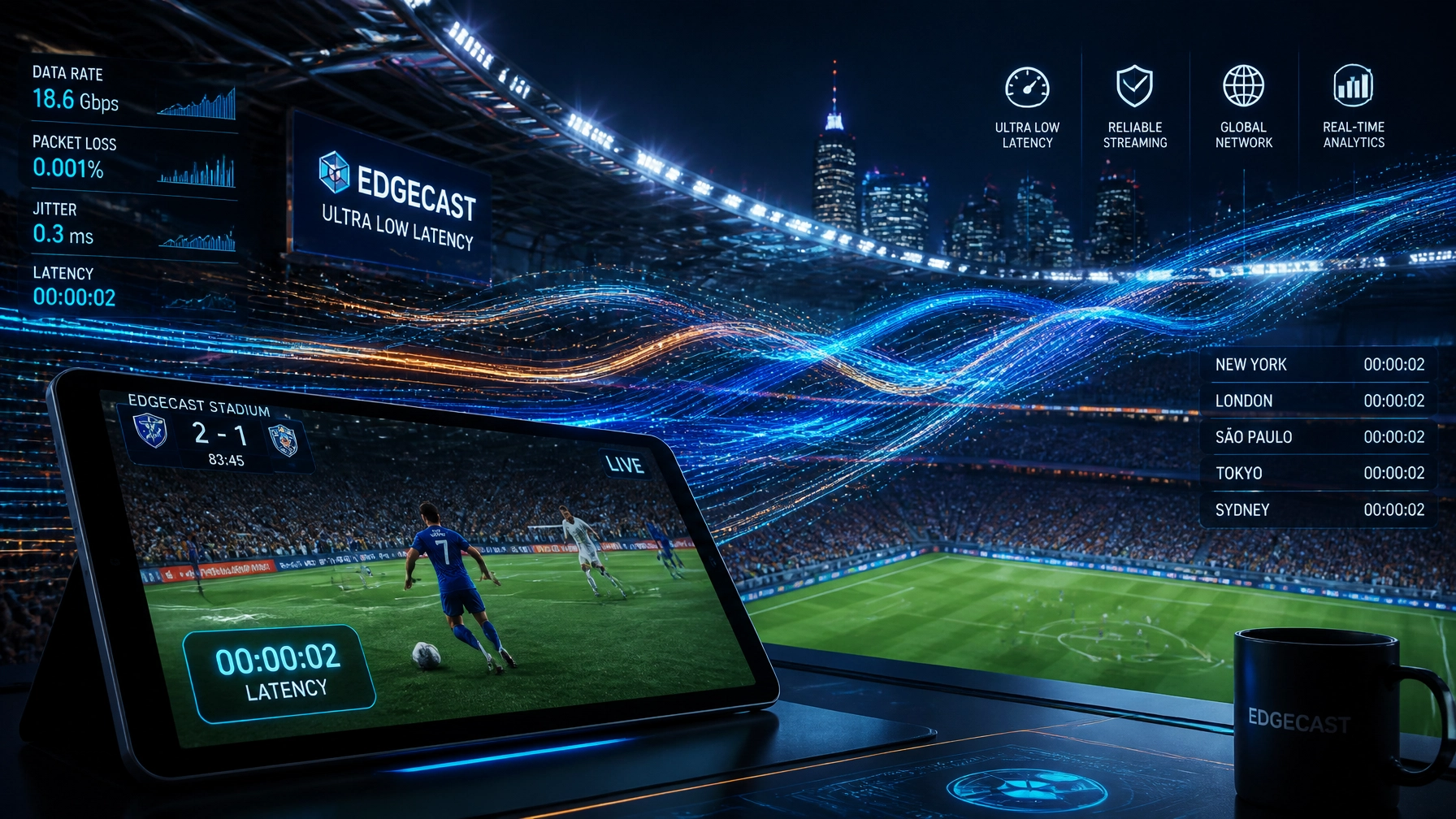
We’ve all been there. You’re watching the championship game on your favorite streaming app. Suddenly, you hear a massive roar from your neighbor’s house. Five seconds later, your phone buzzes with a "GOAL!" notification from a sports app. Finally, ten seconds after that, you actually see the ball hit the net on your screen.
The "Spoiler Effect" is the ultimate buzzkill for live sports. For years, streaming services have lagged behind traditional cable and satellite by 30 seconds or more. But that’s changing. Low-Latency HLS (LL-HLS) is the technology closing that gap, and it's fundamentally reshaping how we consume live sports.
At the Data Transmission Efficiency Alliance (DTEA), we’re watching this shift closely. Because while speed is essential, doing it efficiently is what separates the winners from the losers in the streaming wars.
The Latency Problem: Why Legacy HLS is "Slow"
To understand the solution, you have to understand the problem. Standard HTTP Live Streaming (HLS) was designed for reliability, not speed. It breaks a video into "segments", usually 6 seconds long. The player needs to download a few of these segments before it even starts playing to ensure you don't get a buffering wheel.
By the time the encoder finishes a segment, sends it to the server, and your player downloads a couple of them into its buffer, you’re already 20 to 30 seconds behind reality. For a sitcom, that's fine. For a live Super Bowl bet or a heated Twitter thread, it’s a disaster.

Enter Low-Latency HLS: The Technical Magic
Apple introduced Low-Latency HLS to fix this without breaking the internet. The beauty of HLS is that it works over standard HTTP, which means it scales to millions of viewers easily. LL-HLS keeps that scalability but changes the delivery mechanics.
Here is how it actually works under the hood:
1. Partial Segments (The "Chunk" Method)
Instead of waiting for a full 6-second segment to finish, LL-HLS breaks segments into tiny "parts" (e.g., 200 milliseconds each). The player can start grabbing these parts as they are being generated. This alone shaves seconds off the delay.
2. Preload Hints
The server tells the player, "Hey, I’m about to make a new part. Here is the URL it will be at." The player can then request that data before it even exists. As soon as the data is ready, the server pushes it down the pipe. It’s like pre-ordering a coffee so it’s handed to you the moment you walk in.
3. Blocking Playlist Reloads
In the old days, the player would constantly ask the server, "Is there a new segment yet?" If the answer was "no," it would wait and ask again. LL-HLS allows the player to ask and then wait on the line until the server actually has something new. This removes the "polling" overhead that adds jitter and delay.
Why This Changes the Game for Sports Fans
Reducing latency from 30 seconds to under 3 seconds isn’t just a "nice to have." It unlocks entirely new ways to watch the game.
Real-Time Betting and Micro-Wagering
The sports betting industry is massive. But you can't place a "next point" bet if you're watching a stream that is 20 seconds behind the actual action. LL-HLS brings the stream in sync with the betting odds, allowing for micro-wagers on every play, every pitch, and every penalty.
The End of Spoilers
With LL-HLS, your stream is often faster than cable or satellite. You become the neighbor who cheers first. This synchronization is critical for social media. When everyone sees the goal at the same time, the "global living room" of Twitter and Discord actually works.

Interactive Engagement
Imagine a live poll popping up on your screen asking, "Will he make this free throw?" If the stream is delayed, the free throw has already happened by the time you see the poll. Low latency allows for real-time interaction, multi-camera angle switching on the fly, and even personalized commentary tracks that match the action perfectly.
The Efficiency Trade-off: The DTEA Perspective
Here is the catch: making video go faster usually makes it "heavier." When you use shorter segments and faster encoding presets, you often lose about 5–10% in compression efficiency. This means you’re using more data to deliver the same quality.
For a massive streaming service like Netflix, Prime Video, or a global sports broadcaster, a 10% drop in efficiency translates to millions of dollars in increased bandwidth costs and a significantly higher carbon footprint.
This is where the Data Transmission Efficiency Alliance comes in. We believe you shouldn't have to choose between speed and efficiency. Our mission is to establish the first independent certification system for video compression. We set the benchmarks that prove a technology is not only fast but also resource-smart.
How to Optimize LL-HLS for Maximum Efficiency:
- Tune Your GOP (Group of Pictures): Finding the sweet spot between keyframe frequency and bitrate.
- Adaptive Bitrate (ABR) Logic: Ensuring the player doesn't panic and drop to a lower resolution just because a small "part" was slightly late.
- Edge Computing: Using CDNs that support the latest LL-HLS directives (like Delta Updates) to reduce the amount of metadata sent over the wire.
Benchmarking the Future
As we move toward 2027, the demand for "true live" streaming will only grow. 5G and fiber networks have the capacity, but the protocols and the compression must be optimized.
Streaming companies need to know: Is my LL-HLS implementation actually efficient? Am I burning money on egress fees just to save two seconds of latency?
By seeking DTEA certification, organizations can prove to their stakeholders and customers that they are using world-class data transmission standards. We are moving toward a world where "Live" actually means now, and "Efficient" means sustainable.

Final Thoughts
Low-Latency HLS is more than just a technical update; it’s the bridge that makes digital streaming superior to traditional broadcast. It brings the stadium's energy into our homes without the lag.
If you're a streaming provider, a data center, or a tech developer in the video space, now is the time to audit your transmission efficiency. Don't just get fast: get efficient.
Check out how we are setting the new standards for the industry at DTEA.org.